
How to Choose the Best Water Purifier for Your Home-2026 Buying Guide
Looking for the best water purifier for your home? This complete guide explains how to choose the right RO, UV, UF, or Copper water purifier based on your water quality, family size, and budget. Learn expert tips before you buy.
Choose the Best Water Purifier for Your Home (Without Wasting Money)
Clean drinking water is no longer a luxury—it’s a necessity. Whether you live in a metro city or a small town, the quality of tap water can vary significantly. Contaminants like bacteria, viruses, heavy metals, chlorine, pesticides, and dissolved salts can affect both the taste of your water and your family’s health.
That’s why choosing the best water purifier for your home has become one of the smartest investments you can make.
But here’s the problem.
Search online for “best water purifier,” and you’ll find hundreds of models claiming to be the perfect choice. Should you buy an RO water purifier? Is UV purification enough? Do you really need a Copper RO purifier? Which capacity is ideal for your family?
Don’t worry.
This comprehensive buying guide answers every question in simple language so you can confidently choose the right water purifier without overspending.
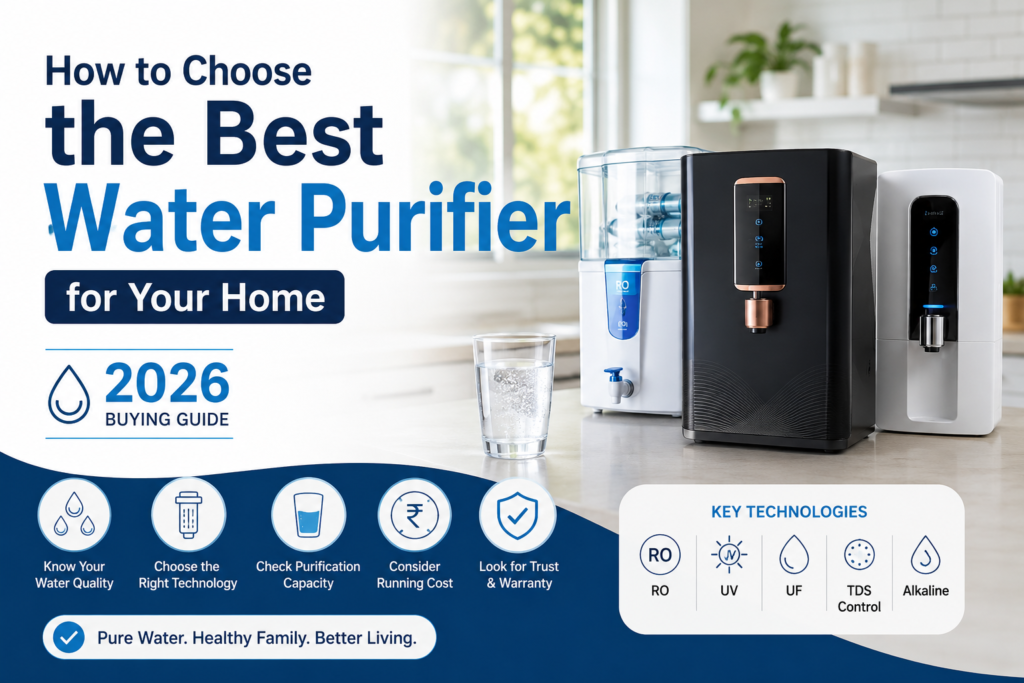
Why Do You Need a Water Purifier?
Even water that appears crystal clear can contain harmful impurities.
Common contaminants include:
- Bacteria
- Viruses
- Heavy metals
- Lead
- Arsenic
- Chlorine
- Pesticides
- Industrial chemicals
- Microplastics
- Dissolved salts
Drinking contaminated water may lead to:
- Stomach infections
- Diarrhea
- Typhoid
- Cholera
- Kidney problems
- Skin issues
- Poor immunity
A quality water purifier removes these contaminants while improving the taste and odor of drinking water.
To choose the Best Water Purifier for Your Home Follow Below Steps
Step 1: Check Your Water Source
This is the most important step.A awareness regarding your water supply at home is must.
Different water sources require different purification technologies.
| Water Source | Recommended Purifier |
|---|---|
| Municipal Corporation Water | UV + UF |
| Borewell Water | RO + UV + UF |
| Tanker Water | RO + UV + UF + TDS Controller |
| Mixed Water Supply | RO Water Purifier |
If your water comes from multiple sources during the year, choosing an RO water purifier is generally the safest option.
Step 2: Understand TDS (Total Dissolved Solids)
One of the biggest mistakes buyers make is purchasing an RO purifier without knowing their water’s TDS level.
What is TDS?
TDS stands for Total Dissolved Solids, which measures dissolved minerals and salts in water.
Recommended TDS Levels
| TDS Level | Water Quality | Recommended Purifier |
|---|---|---|
| Below 150 ppm | Soft Water | UV/UF |
| 150-300 ppm | Good | UV or RO |
| 300-500 ppm | Moderate | RO |
| Above 500 ppm | Hard Water | RO + UV |
You can easily measure TDS using an inexpensive digital TDS meter.
Step 3: Know the Different Types of Water Purifiers
1. RO Water Purifier (Reverse Osmosis)
Best For
- Borewell water
- High TDS water
- Tanker water
Pros
✔ Removes heavy metals
✔ Reduces TDS
✔ Removes pesticides
✔ Eliminates dissolved salts
✔ Improves taste
Cons
- Produces wastewater
- Slightly higher maintenance
2. UV Water Purifier
Best For
Municipal water with low TDS.
Pros
- Kills bacteria
- Destroys viruses
- No water wastage
- Low maintenance
Cons
Cannot remove dissolved salts.
3. UF Water Purifier
UF (Ultrafiltration) removes larger particles without electricity.
Best For
Low TDS water.
4. RO + UV + UF Water Purifier
This combination offers the highest level of purification and is suitable for most Indian households.
It:
- Removes dissolved salts
- Kills germs
- Removes sediments
- Improves taste
- Provides multi-stage purification
Step 4: Choose the Right Storage Capacity
Storage depends on your family size.
| Family Members | Storage Capacity |
|---|---|
| 1-2 | 5-7 Litres |
| 3-4 | 7-8 Litres |
| 5-6 | 8-10 Litres |
| Large Families | 10 Litres or More |
Larger storage ensures uninterrupted access to purified water during power cuts.
Step 5: Look for Multi-Stage Purification
Modern water purifiers often include multiple purification stages such as:
- Sediment Filter
- Pre Carbon Filter
- RO Membrane
- UV Chamber
- UF Membrane
- Activated Carbon
- Mineral Cartridge
- Copper Infusion
- Alkaline Filter
The more effective the purification stages, the safer the drinking water.
Step 6: Check the Recovery Rate
Older RO systems used to waste large amounts of water.
Today’s premium models offer recovery rates of 50–70%, making them more water-efficient.
Choosing a purifier with a higher recovery rate helps reduce water wastage.
Step 7: Don’t Ignore Maintenance Costs
Many buyers only consider the purchase price.
Annual maintenance is equally important.
Typical maintenance includes:
- Sediment filter replacement
- Carbon filter replacement
- RO membrane replacement (when required)
- UV lamp replacement
- General servicing
Look for brands with affordable Annual Maintenance Contracts (AMCs) and easily available spare parts.
Step 8: Features Worth Paying For
Modern water purifiers come with several useful features:
- Smart LED Display
- Filter Change Indicator
- Tank Full Indicator
- Auto Shut-Off
- Child Lock
- TDS Adjuster
- Mineral Enhancer
- Copper Enrichment
- Alkaline Water Technology
- Smart App Connectivity
- Leak Detection
- Energy Saving Mode
Choose features that genuinely add convenience rather than paying extra for gimmicks.
Step 9: Consider Electricity Availability
If your area experiences frequent power cuts, choose a purifier with a built-in storage tank.
Some UF-based purifiers can operate without electricity, but they are suitable only for low-TDS water.
Step 10: Buy from a Trusted Brand
Reliable brands usually offer:
- Better service network
- Genuine spare parts
- Warranty support
- Certified purification technology
A good warranty and responsive after-sales service can save you time and money in the long run.
Common Mistakes to Avoid
❌ Buying an RO purifier without checking TDS
❌ Choosing the cheapest model available
❌ Ignoring maintenance costs
❌ Purchasing insufficient storage capacity
❌ Not checking warranty terms
❌ Overlooking after-sales service availability
Quick Buying Checklist
Before purchasing a water purifier, ask yourself:
✅ What is my water source?
✅ What is the TDS level?
✅ How many family members will use it?
✅ Do I need RO, UV, UF, or a combination?
✅ What is the annual maintenance cost?
✅ Does it include a warranty?
✅ Is after-sales service available in my area?
Which Water Purifier Should You Choose?
| Your Requirement | Best Choice |
|---|---|
| Borewell Water | RO + UV + UF |
| Municipal Water | UV + UF |
| Tanker Water | RO + UV + UF |
| Hard Water | RO |
| Large Family | 8–10 L Storage RO |
| Frequent Power Cuts | Storage Water Purifier |
| Budget-Friendly | UV/UF (for low-TDS water) |
Frequently Asked Questions (FAQs)
Is RO better than UV?
RO is better for water with high TDS or dissolved impurities, while UV is ideal for low-TDS municipal water. If you’re unsure, an RO + UV + UF purifier offers broader protection.
Is a Copper water purifier worth buying?
Copper-enriched water purifiers add trace amounts of copper after purification. While copper is an essential mineral, most people already get enough through their diet. Consider it an optional feature rather than a necessity.
How often should I service my water purifier?
Basic servicing is recommended every 6–12 months, depending on your water quality and usage. Filters and membranes should be replaced according to the manufacturer’s recommendations.
How much storage is enough for a family of four?
A purifier with 7–8 litres of storage is generally sufficient for a family of four.
Can I use an RO purifier for municipal water?
Yes, but if your municipal water has low TDS, an RO purifier may remove beneficial minerals unnecessarily. Check the TDS level first or choose a purifier with a TDS controller or mineral cartridge.
Final Thoughts-Choose the Best Water Purifier for Your Home
Choosing the best water purifier isn’t about buying the most expensive model—it’s about selecting one that matches your water source, TDS level, family size, and maintenance budget. By understanding the differences between RO, UV, and UF technologies, checking your water quality, and considering long-term costs, you can make a smart purchase that keeps your family safe and healthy for years to come.
Check The Best Water Purifier @Amazon