
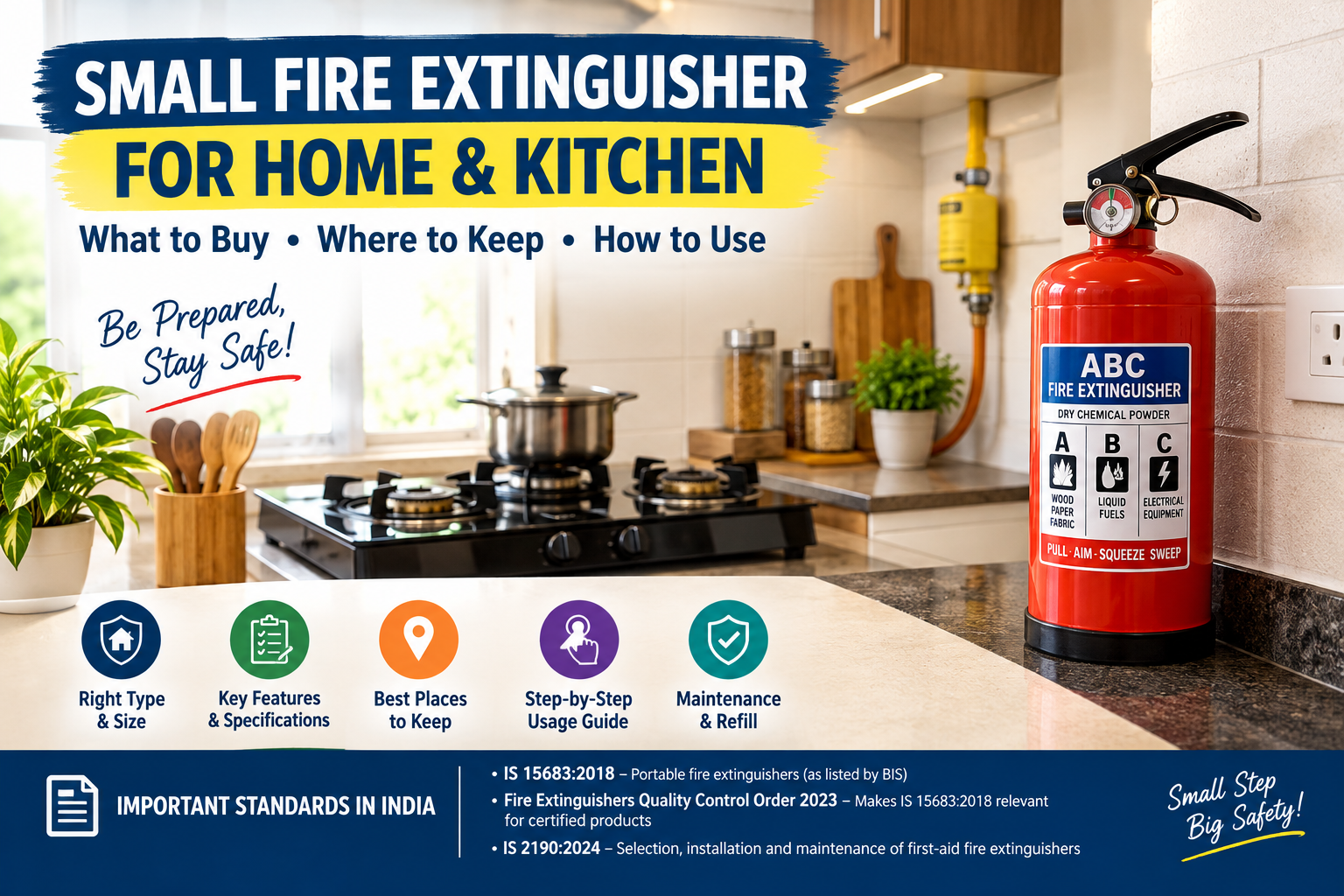
Small Fire Extinguisher for Home & Kitchen: Complete Buying Guide for 2026
A fire can start in a kitchen in seconds.
One moment you are frying something on the stove, and the next moment a pan of cooking oil can suddenly catch fire. An overloaded electrical socket can also become dangerously hot, while an LPG-related incident can turn into a serious emergency if it is not handled correctly.
This is why a small fire extinguisher for home and kitchen is becoming an increasingly important safety product for Indian households.
But buying any fire extinguisher is not enough.
The type of fire extinguisher, extinguishing agent, fire rating, capacity, certification, installation location and maintenance all matter. A fire extinguisher designed for one type of fire may be unsuitable—or potentially dangerous—for another.
So, what is the best fire extinguisher for home and kitchen?
The answer depends on what you are trying to protect.
In this detailed guide, we will explain everything you need to know before buying a home fire extinguisher, including the best types for kitchens, electrical fires, LPG-related risks and ordinary household fires.
Important: A portable fire extinguisher is intended for an early-stage, small and manageable fire. If flames are spreading rapidly, smoke is heavy, your escape route is threatened, or you are unsure whether you can safely fight the fire, evacuate immediately and call the fire service.
Why Every Home Should Consider Keeping a Fire Extinguisher
Many people associate fire extinguishers with offices, factories, hotels and commercial buildings.
But your home also contains several potential sources of ignition:
- LPG or PNG cooking appliances
- Electrical appliances
- Microwave ovens
- Induction cooktops
- Refrigerators
- Washing machines
- Extension boards
- Chargers and adapters
- Toasters and kettles
- Oil and ghee used for cooking
- Curtains and furniture
- Paper and cardboard
- Wooden kitchen cabinets
- Candles and incense
- Inverters and batteries
The kitchen deserves particular attention because it combines heat, electricity, cooking oil and combustible materials in a relatively small area.
India’s Directorate General Fire Services, Civil Defence & Home Guards advises householders to stay focused while cooking, avoid leaving a hot stove unattended, and keep a fire extinguisher available in the kitchen.
The Telangana Fire Disaster Response and Civil Defence Department also advises residential occupants to keep LPG stoves properly positioned and ventilated and specifically recommends mounting a dry-chemical extinguisher in the kitchen away from the stove.
That last point is extremely important:
Your extinguisher should be easy to reach—but it should not be sitting directly beside the stove where a fire could block access to it.
What Is a small fire extinguisher for home and kitchen?
A small fire extinguisher for home is a portable firefighting device designed to discharge an extinguishing agent onto a small fire.
Depending on the model, the agent may be:
- Dry chemical powder
- Carbon dioxide (CO₂)
- Foam
- Water
- Water mist
- Wet chemical
- Clean agent
Indian Standard IS 15683:2018 covers portable fire extinguishers and their performance, construction and safety requirements. BIS also lists portable fire extinguishers under the Fire Extinguishers Quality Control Order.
This means that when you are searching online for a fire extinguisher for home, you should not simply choose the cheapest cylinder you can find.
Look at the standard, certification, fire rating, extinguishing agent and intended fire classes.
What Size Fire Extinguisher Is Best for a Home?
This is one of the most common questions:
“Should I buy a 1 kg, 2 kg or 4 kg fire extinguisher for my home?”
There is no single capacity that is perfect for every house.
For many households, a compact extinguisher is attractive because it is:
- Easier to handle
- Easier to mount
- Easier to store
- Suitable for an early-stage emergency
- More convenient for elderly family members
However, a larger extinguisher generally contains more extinguishing agent and can provide greater firefighting capacity.
BIS documentation for portable extinguishers covers a range of capacities depending on the extinguisher type. For example, powder-based portable extinguishers covered by IS 15683 include capacities such as 1 kg, 2 kg, 4 kg, 6 kg, 9 kg and 12 kg.
A practical way to think about capacity
| Capacity | Typical consideration |
|---|---|
| 1 kg | Very compact; useful for small, specific risks |
| 2 kg | Convenient household size for many applications |
| 4 kg | More agent and generally greater capacity |
| 6 kg+ | More substantial; may be appropriate for larger or higher-risk areas |
The right choice depends on your home’s layout, hazards, extinguisher rating and the manufacturer’s certified application.
Don’t choose purely by kilograms.
A 2 kg extinguisher with the appropriate rating and agent may be more useful for a particular hazard than a larger extinguisher that is unsuitable for that fire.
Which Type of Fire Extinguisher Is Best for Home?
There are several types, and this is where many buyers make mistakes.
Let’s look at the major options.
1. ABC Dry Powder Fire Extinguisher
An ABC fire extinguisher is one of the most commonly encountered multipurpose extinguisher types.
It is designed for specified Class A, B and C hazards according to its certification and marking.
Class A hazards generally involve ordinary combustible materials.
Class B hazards involve flammable liquids.
Class C hazards are addressed according to the applicable fire classification system and standard.
ABC dry powder extinguishers are popular because they provide broad household coverage.
They can be useful where a home has a combination of risks such as:
- Paper
- Wood
- Cloth
- Certain plastics
- Flammable liquids
- Some electrical hazards, where the extinguisher is specifically marked as suitable
However, powder creates residue.
That means you may not want to use it around sensitive electronic equipment unless the extinguisher is appropriate for that application.
Advantages of ABC powder extinguishers
- Multipurpose application
- Widely available
- Useful for several household fire risks
- Compact models are available
- Often relatively affordable
Disadvantages
- Leaves powder residue
- Cleanup can be significant
- Not automatically the best choice for every kitchen fire
- Must be used only for the fire classes indicated on its label
2. CO₂ Fire Extinguisher
A CO₂ fire extinguisher is commonly associated with electrical equipment and certain flammable-liquid fires.
One major advantage is that CO₂ does not leave the same type of powder residue associated with ABC extinguishers.
That can make CO₂ attractive around certain electrical and electronic equipment.
However, CO₂ is not a universal solution for every household fire.
It also has limitations, particularly outdoors or where the agent can dissipate quickly.
For a home, consider CO₂ where electrical equipment represents a significant concern—but always check the extinguisher’s certified fire ratings and instructions.
3. Water Fire Extinguisher
Water extinguishers are intended for appropriate Class A combustible-material fires.
Examples include:
- Paper
- Cardboard
- Wood
- Cloth
But water should not be treated as a universal fire extinguisher.
Never assume water is suitable for an electrical fire.
Water can also be extremely dangerous when improperly used on burning cooking oil.
If a pan of oil catches fire, do not throw water into it.
The water can rapidly turn to steam and cause burning oil to spread violently.
4. Foam Fire Extinguisher
Foam extinguishers can be suitable for certain Class A and Class B hazards, depending on their certification.
They may be useful in environments where ordinary combustibles and flammable liquids are both present.
However, just because an extinguisher contains foam does not automatically make it appropriate for every kitchen or electrical hazard.
Always read the manufacturer’s fire-class markings.
5. Wet Chemical Fire Extinguisher for Kitchen Fires
This is a particularly important category for anyone searching for a kitchen fire extinguisher.
Cooking oil and fat fires are treated as Class F hazards under IS 2190:2024. The standard specifically states that Class F extinguishers are provided for hazards involving combustible cooking media such as vegetable or animal oils and fats in cooking appliances.
This is why you should pay particular attention to the fire rating when buying an extinguisher for a kitchen where deep frying or large quantities of cooking oil are used.
A product marketed specifically for cooking-oil fires may therefore be different from an ordinary ABC extinguisher.
If you frequently deep-fry food
Consider looking specifically for an extinguisher that is certified and marked for the relevant cooking-oil/fire class, rather than assuming that every ABC extinguisher is suitable.
What Is the Best Fire Extinguisher for a Kitchen?
There is no universal answer because kitchens have different hazards.
A typical Indian kitchen may contain:
- LPG or PNG stove
- Cooking oil
- Electrical appliances
- Microwave oven
- Refrigerator
- Mixer grinder
- Induction cooktop
- Toaster
- Electric kettle
- Wooden cabinets
- Curtains
- Paper packaging
Therefore, choosing a kitchen fire extinguisher should start with identifying the actual hazards.
For ordinary combustible materials
An appropriately rated ABC extinguisher may be useful.
For electrical equipment
Choose an extinguisher specifically marked as suitable for energized electrical equipment.
For cooking oil
Look for an extinguisher specifically certified for the applicable Class F cooking-media hazard.
IS 2190:2024 specifically addresses Class F hazards involving cooking oils and fats. (Bureau of Indian Standards)
Can an ABC Fire Extinguisher Be Used in the Kitchen?
This is a very common search question.
The answer is: it depends on the fire.
An ABC extinguisher can be useful for several household fire scenarios, but cooking-oil fires require particular care.
If oil in a frying pan catches fire:
Do not throw water on the flames.
Instead:
- Keep calm.
- If it is safe to do so, turn off the heat source.
- Do not carry the burning pan.
- Do not pour water onto burning oil.
- Use an appropriate extinguisher for the cooking-oil hazard if you are trained and it is safe.
- If the fire is growing or you cannot safely control it, evacuate immediately.
Never put yourself between a fire and your escape route.
Fire Extinguisher for Electrical Fire at Home
Modern homes contain more electrical equipment than ever.
Think about how many devices can be connected to your home’s electrical system:
- Television
- Refrigerator
- Washing machine
- Air conditioner
- Laptop
- Mobile chargers
- UPS
- Inverter
- Microwave
- Induction cooktop
- Water heater
- Extension boards
Electrical faults can lead to overheating, arcing and fire.
IS 2190:2024 states that electrical hazards should be addressed with extinguishers suitable for use on energized electrical equipment, with the equipment de-energized as soon as possible to prevent re-ignition. (Bureau of Indian Standards)
Important safety rule
Never assume that any extinguisher is safe for energized electrical equipment.
Check the label.
And where it can be done safely, disconnect electrical power.
Do not put yourself at risk trying to reach an electrical switch that is already surrounded by flames.
What About an LPG or Gas Stove Fire?
LPG and PNG appliances introduce another important household risk.
If a gas-fed fire occurs, simply extinguishing the flame without addressing the gas supply can create another hazard.
If you smell gas:
- Do not operate electrical switches unnecessarily.
- Do not create sparks.
- Shut off the gas supply only if it is safe to do so.
- Move people away from the area.
- Ventilate only when it can be done safely.
- Contact the appropriate emergency service or gas provider when necessary.
The Telangana Fire Disaster Response and Civil Defence Department advises households to keep LPG stoves on raised platforms in well-ventilated locations and to turn off the cylinder valve and burner knob after cooking.
Look for BIS Compliance When Buying a Fire Extinguisher in India
This is one of the most important points in this entire article.
If you are buying a fire extinguisher in India, don’t select a product merely because it has a low price or attractive packaging.
Look for the relevant Indian Standard and certification.
BIS lists IS 15683:2018 — Portable Fire Extinguishers — Performance and Construction — Specification. The standard covers portable extinguishers and their performance, reliability and safety. (Bureau of Indian Standards)
The Fire Extinguishers Quality Control Order, 2023 also appears in BIS’s list of products covered under the compulsory certification scheme for IS 15683. (BIS)
What should you check?
Before purchasing, look for:
- BIS/ISI certification information
- Applicable Indian Standard
- Manufacturer’s name
- Manufacturing details
- Extinguishing agent
- Capacity
- Fire ratings
- Operating instructions
- Pressure information where applicable
- Maintenance information
- Authentic certification details
Avoid products where certification information is unclear or impossible to verify.
Why Fire Rating Matters More Than Just Size
Imagine you see two fire extinguishers online.
One weighs 2 kg.
The other weighs 4 kg.
It may be tempting to assume the 4 kg model is automatically better.
That is not necessarily true.
Fire extinguishers are tested and rated for specific fire hazards.
BIS documentation includes fire-rating requirements for different extinguisher types and capacities. For example, older BIS documentation shows that the declared Class B ratings of ABC dry-powder extinguishers vary with capacity. (BIS)
Therefore, when comparing products, don’t look only at:
“How many kilograms?”
Also ask:
“What fire is this extinguisher actually tested and rated to fight?”
Where Should You Keep a Home Fire Extinguisher?
Location is just as important as buying the extinguisher.
Imagine a kitchen fire starts.
You run to the extinguisher.
But it is stored inside a cupboard next to the stove.
The fire is already blocking that area.
The extinguisher is technically available—but practically useless.
IS 2190:2024 states that extinguishers should be conspicuously located, readily accessible and immediately available, and should not be obstructed or obscured. It also provides installation requirements for portable extinguishers. (Bureau of Indian Standards)
Good locations can include:
- Near the kitchen entrance
- Along an accessible escape route
- In an easily visible location
- Near—but not directly beside—the kitchen hazard
- Away from excessive heat
- In a properly mounted bracket
Avoid placing it:
- Behind the stove
- Inside a locked cupboard
- Behind heavy appliances
- On the floor where it can be knocked over
- In a location that becomes inaccessible during a fire
Should a Fire Extinguisher Be Mounted on the Wall?
For a home, wall mounting can be a practical option.
It keeps the extinguisher:
- Visible
- Accessible
- Off the floor
- Easy to locate
- Less likely to be accidentally knocked over
IS 2190:2024 provides requirements for mounting portable extinguishers and states that extinguishers of gross mass 17 kg or less should be installed so that their top is not more than 1.5 metres above the floor. (Bureau of Indian Standards)
Always follow the manufacturer’s mounting instructions and the applicable installation standard.
How to Use a Fire Extinguisher: PASS Method
Buying a fire extinguisher is only half the job.
You should also know how to operate it.
A commonly taught method is:
P — Pull
Pull the safety pin.
A — Aim
Aim the nozzle at the base of the fire, not the top of the flames.
S — Squeeze
Squeeze the operating handle.
S — Sweep
Sweep the nozzle from side to side across the base of the fire.
The Indian government’s ATL fire-extinguisher guidance also describes the PASS method and emphasizes using an extinguisher for small fire.
But remember:
Don’t wait until the fire becomes large.
An extinguisher is an early-response tool, not a replacement for evacuation or professional firefighting.
If the fire is rapidly increasing, smoke is overwhelming, the extinguisher does not work, or your escape path is threatened:
Leave immediately.
What You Should Never Do During a Kitchen Fire
Some mistakes can make a small kitchen fire dramatically worse.
Never throw water on burning cooking oil
This is one of the most dangerous mistakes.
Water and hot oil can react violently and cause burning oil to spread.
Never try to carry a burning pan outside
Moving a burning pan can spread the fire and expose you to serious burns.
Never stand between the fire and your exit
You need an escape route behind you.
Never fight a fire that is already too large
A portable extinguisher is designed for an appropriate early-stage fire—not a fully developed room fire.
Never use an extinguisher without checking its application
Different extinguishing agents are designed for different hazards.
How Often Should a Fire Extinguisher Be Checked?
A fire extinguisher should not simply be purchased and forgotten.
Check it periodically for obvious problems such as:
- Physical damage
- Corrosion
- Leakage
- Missing safety pin
- Damaged hose or nozzle
- Pressure indication where applicable
- Tampering
- Expired or missing inspection information
IS 2190:2024 states that extinguishers should be maintained in a fully charged and operable condition and kept in their designated places. (Bureau of Indian Standards)
Follow the manufacturer’s maintenance requirements and applicable Indian standards for inspection, servicing and testing.
How Long Does a Fire Extinguisher Last?
There isn’t one universal answer such as “all extinguishers last exactly X years.”
Service life and maintenance requirements depend on:
- Extinguisher type
- Manufacturer
- Construction
- Operating environment
- Applicable standard
- Inspection findings
- Pressure testing requirements
Never keep using an extinguisher simply because it “looks fine.”
A fire extinguisher is a pressure-containing safety device.
Professional inspection and servicing matter.
Fire Extinguisher Price in India: What Should You Expect?
If you search Google for:
“fire extinguisher price”
you will find products across a wide range of prices.
The price can vary according to:
- Capacity
- Extinguishing agent
- Fire rating
- Certification
- Brand
- Construction
- Pressure system
- Mounting accessories
- Maintenance requirements
Don’t make lowest price your primary buying criterion.
A fire extinguisher is not a decorative product.
It is emergency equipment that you may depend on when seconds matter.
A cheaper product with unclear certification may not provide the same confidence as a properly certified product from a legitimate manufacturer.
10 Things to Check Before Buying a Small Fire Extinguisher for Home
Use this checklist before clicking the “Buy Now” button.
1. Check the Indian Standard
Look for relevant BIS requirements, particularly IS 15683 for portable extinguishers. (Bureau of Indian Standards)
2. Check the fire rating
Don’t buy based on capacity alone.
3. Identify your home’s major hazards
Think about LPG, cooking oil, electrical appliances and ordinary combustibles.
4. Choose the correct extinguishing agent
ABC powder, CO₂, water, foam, wet chemical and other agents have different applications.
5. Check the manufacturer’s information
Avoid products with unclear origins.
6. Check the instructions
You should be able to understand how to operate it quickly.
7. Consider the weight
A family member must be able to handle it safely.
8. Consider the installation location
It should be accessible without entering the fire zone.
9. Check maintenance requirements
Know when it needs inspection or servicing.
10. Don’t forget the kitchen
The kitchen often deserves special consideration because cooking oil creates a specific fire hazard.
Small Fire Extinguisher vs Large Fire Extinguisher
Which is better?
Again, there is no universal winner.
Small extinguisher
Advantages:
- Lightweight
- Easy to handle
- Convenient for apartments
- Takes less storage space
- Easier to mount
Limitations:
- Smaller quantity of extinguishing agent
- Potentially shorter discharge capability
- May have lower fire rating than larger models
Larger extinguisher
Advantages:
- More extinguishing agent
- Potentially greater fire-fighting capability
- Suitable for larger hazards when correctly rated
Limitations:
- Heavier
- More difficult for some people to operate
- Requires more storage space
For a typical apartment, a compact properly certified extinguisher may be convenient, but the correct choice should be based on the actual hazards and the extinguisher’s certified rating.
Should You Buy One Fire Extinguisher or More Than One?
This depends on the size and layout of your home.
A larger house may benefit from more than one strategically positioned extinguisher.
For example, you might consider separate locations for:
- Kitchen
- Garage
- Utility area
- Workshop
- Electrical equipment area
The important principle is accessibility.
An extinguisher that is 30 seconds away may not be as useful as one that is immediately accessible.
Don’t put every extinguisher in one cupboard.
Fire Blanket vs Fire Extinguisher for Kitchen
A fire blanket can be another useful kitchen safety item.
It may be helpful for certain small fires, particularly when the fire can safely be smothered.
However, a fire blanket and fire extinguisher are not necessarily substitutes.
For a household kitchen, having appropriate fire protection equipment—and knowing how to use it—is generally more useful than relying on one product for every possible situation.
What Is the Best Fire Extinguisher for an Indian Home?
Instead of asking:
“Which extinguisher is the best?”
ask these five questions:
What can burn?
Cooking oil? LPG? Electrical appliances? Wood? Paper?
Where can the fire start?
Kitchen? Living room? Garage? Utility room?
How large is the hazard?
A small apartment kitchen has different requirements from a large independent house with a garage and workshop.
Can everyone in the home operate it?
A technically excellent extinguisher is not useful if the intended user cannot safely handle its weight.
Is it properly certified and maintained?
This is critical.
Quick Buying Guide
| Home Hazard | What to Look For |
|---|---|
| Paper, wood, cloth | Appropriate Class A-rated extinguisher |
| Flammable liquids | Appropriate Class B-rated extinguisher |
| Electrical equipment | Extinguisher specifically marked suitable for energized electrical equipment |
| Cooking oil/fat | Appropriate Class F-rated extinguisher |
| Mixed household hazards | A properly rated multipurpose extinguisher may be considered |
| Sensitive electronics | Consider an appropriate clean-agent or CO₂ solution where applicable |
Always verify the actual fire classes and ratings printed on the specific extinguisher.
Frequently Asked Questions
What is the best small fire extinguisher for home?
For a home, the appropriate extinguisher depends on the hazards present. A properly certified multipurpose extinguisher can address several common household risks, while kitchens involving significant cooking-oil hazards may require specific Class F protection.
What is the best fire extinguisher for kitchen use?
It depends on the type of fire. For cooking oils and fats, look for an extinguisher specifically rated for Class F hazards. For other kitchen risks such as ordinary combustibles or electrical equipment, the appropriate rating and extinguishing agent may be different. (Bureau of Indian Standards)
Can I use an ABC extinguisher on an electrical fire?
Only if the specific extinguisher is marked and certified as suitable for energized electrical equipment. Always check the product label and applicable instructions.
Can I use water on a kitchen oil fire?
No. Never throw water onto burning cooking oil.
Is a 1 kg fire extinguisher enough for a home?
Capacity alone doesn’t determine whether an extinguisher is adequate. Check its fire rating, application, location and the hazard you are protecting.
Where should I keep a kitchen fire extinguisher?
Keep it in a visible, easily accessible location away from the stove and away from a position where a fire could block access. IS 2190:2024 emphasizes accessibility and unobstructed placement. (Bureau of Indian Standards)
How much does a home fire extinguisher cost?
Prices vary according to capacity, extinguishing agent, certification, fire rating, manufacturer and other specifications. Compare the complete specification rather than choosing solely on price.
Is BIS certification important for fire extinguishers in India?
Yes. BIS identifies IS 15683:2018 as the standard for portable fire extinguishers, and portable fire extinguishers are included in the applicable compulsory certification framework. (BIS)
Final Checklist: Your Home Fire Safety Kit
A fire extinguisher is only one part of home fire safety.
Consider keeping:
- ✔ Properly certified fire extinguisher
- ✔ Smoke alarm(s)
- ✔ Fire blanket where appropriate
- ✔ Clearly understood emergency numbers
- ✔ Unblocked escape routes
- ✔ Safe LPG practices
- ✔ Proper electrical wiring
- ✔ Avoidance of overloaded sockets
- ✔ Basic family fire-safety training
The Directorate General Fire Services, Civil Defence & Home Guards also emphasizes avoiding overloaded sockets and maintaining safe kitchen practices.
Final Word: Don’t Wait Until You Need One
Most people don’t think about fire extinguishers while everything is going normally.
That’s exactly why preparation matters.
A small fire extinguisher for home takes up very little space compared with the potential damage caused by an uncontrolled fire.
But remember that buying the first inexpensive extinguisher you find online isn’t the goal.
The goal is to choose the right type, appropriate fire rating, suitable capacity and properly certified product, install it where it can actually be reached, maintain it correctly and make sure the people at home know what to do.
For Indian households, pay particular attention to kitchen fires, cooking oil, LPG and electrical equipment.
And perhaps the most important rule of all:
If a fire is too large to control safely, don’t become part of the emergency. Get out, stay out and call the fire service.
Your extinguisher is a tool for dealing with an appropriate early-stage fire—not a reason to take unnecessary risks.Check the best offers at Amazon