
Induction Cooktop vs Gas Stove: Which Saves More Money?
With rising electricity tariffs and increasing LPG cylinder prices, choosing the right cooking appliance has become more important than ever. One of the most common questions homeowners ask today is: Induction Cooktop vs Gas Stove – which saves more money? While both options have their own advantages, the real answer depends on factors such as your cooking habits, energy efficiency, maintenance costs, and long-term usage.
Modern induction cooktops have gained immense popularity in India due to their fast heating, energy efficiency, and advanced safety features. On the other hand, the traditional gas stove continues to be the preferred choice for many families because of its familiarity, ability to cook during power cuts, and compatibility with all types of cookware. But when it comes to monthly cooking expenses, electricity consumption, LPG refill costs, and overall value for money, which one comes out ahead?
In this detailed comparison, we’ll break down the cost of cooking on an induction cooktop vs gas stove, compare power consumption, efficiency ratings, maintenance costs, speed, safety, and environmental impact. We’ll also calculate real-world cooking costs so you can clearly understand which appliance is more economical for your home.
Whether you’re planning to buy your first induction cooktop, thinking about replacing your old gas stove, or simply looking for ways to reduce your monthly kitchen expenses, this guide will help you make an informed decision. By the end of this article, you’ll know exactly which option offers the best savings, better performance, and greater convenience for your lifestyle, helping you invest wisely while keeping your cooking costs under control.
Induction Cooktop vs Gas Stove: Which Saves More Money?
With LPG cylinder prices increasing almost every year and electricity becoming more affordable in many states, thousands of Indian households are asking one important question:
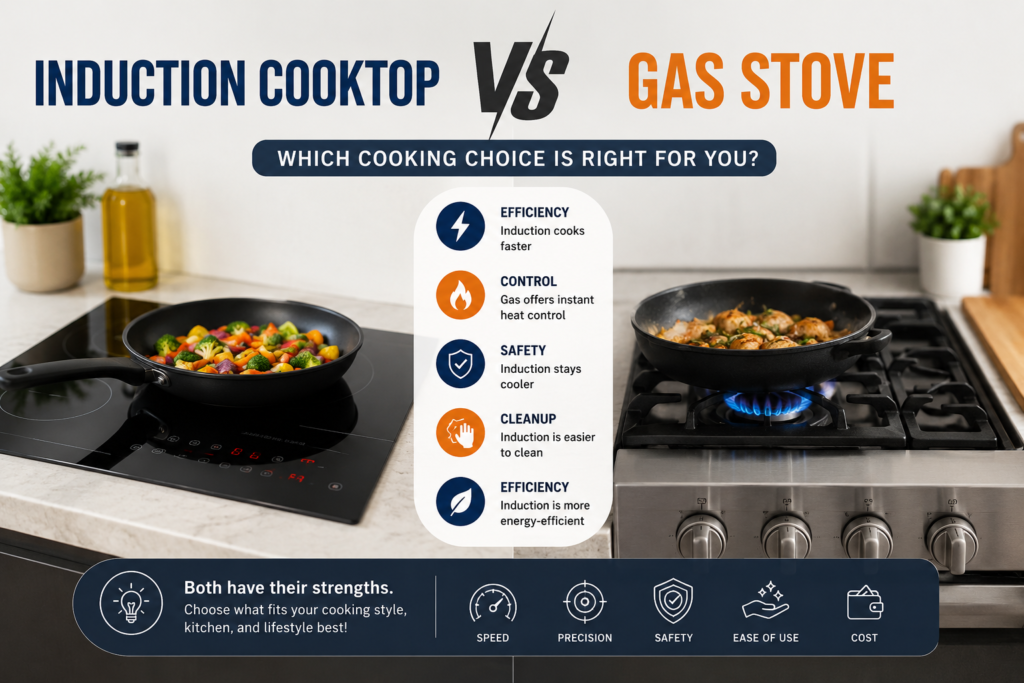
Should I continue using a gas stove or switch to an induction cooktop?
The answer isn’t as simple as choosing the cheaper appliance. You also need to consider electricity consumption, LPG refill costs, cooking speed, maintenance, safety, durability, and long-term savings.
In this detailed comparison, we’ll compare Induction Cooktop vs Gas Stove on every important factor so that you can choose the best option for your kitchen.
Induction Cooktop vs Gas Stove: Quick Comparison Table
| Feature | Induction Cooktop | Gas Stove |
|---|---|---|
| Initial Cost | ₹1,500–₹5,000 | ₹2,000–₹8,000 |
| Fuel Cost | Electricity | LPG |
| Cooking Speed | Very Fast | Moderate |
| Energy Efficiency | 85–90% | 35–55% |
| Heat Loss | Very Low | High |
| Safety | Excellent | Moderate |
| Cleaning | Very Easy | Time Consuming |
| Indoor Pollution | None | Present |
| Portable | Yes | No |
| Works During Power Cut | No | Yes |
| Best For | Small families, students, apartments | Large families, frequent cooking |
What is an Induction Cooktop?
An induction cooktop uses electromagnetic technology to directly heat compatible cookware instead of heating the cooking surface.
Unlike traditional stoves, there is no open flame. This makes induction cooking:
- Faster
- Cleaner
- More energy efficient
- Safer for children
How Does a Gas Stove Work?
A gas stove burns LPG (Liquefied Petroleum Gas) to produce heat.
The flame heats the vessel first, which then transfers heat to the food.
While gas cooking is traditional and familiar, a significant amount of heat escapes into the surrounding air, making it less efficient.
Induction Cooktop vs Gas Stove: Which One is Cheaper to Use?
This is the most important question.
Let’s calculate using average Indian prices.
Example
Suppose:
- Electricity Cost = ₹8/unit
- Induction Power = 1800W
- Cooking Time = 1 hour/day
Electricity used daily
= 1.8 units
Daily Cost
= 1.8 × ₹8
= ₹14.40/day
Monthly Cost
≈ ₹430
Now compare with LPG.
Average LPG cylinder price
≈ ₹950
Cylinder lasts
≈ 35 days
Monthly Cost
≈ ₹730–₹900
You can save approximately ₹250–₹450 every month, depending on electricity tariffs and cooking habits.
Energy Efficiency Comparison
One of the biggest advantages of induction cooking is efficiency.
| Appliance | Efficiency |
|---|---|
| Induction Cooktop | 85–90% |
| Gas Stove | 35–55% |
This means induction transfers almost all energy directly into the utensil.
Gas loses nearly half its energy into the surrounding air.
Cooking Speed Comparison
Boiling 1 litre of water
Gas Stove
≈ 7–9 minutes
Induction
≈ 4–5 minutes
Induction cooktops are almost 40–50% faster.
Less cooking time also means lower electricity consumption.
Electricity Consumption of an Induction Cooktop
Many buyers worry:
Does an induction cooktop consume a lot of electricity?
Not really.
Average Power Ratings
- 1200W
- 1500W
- 1800W
- 2000W
If you cook for one hour daily on a 1800W induction:
Daily Consumption
1.8 units
Monthly Consumption
54 units
Even at ₹8 per unit, the monthly cost remains affordable.
LPG Price vs Electricity Cost
| Expense | Gas Stove | Induction |
|---|---|---|
| Monthly Fuel Cost | ₹700–₹900 | ₹350–₹500 |
| Annual Cost | ₹8,500+ | ₹4,500–₹6,000 |
Annual Savings
Around ₹3,000–₹4,000
Over five years
Savings can exceed ₹15,000–₹20,000.
Safety Comparison
Induction Cooktop
✔ No open flame
✔ Auto shut-off
✔ Overheat protection
✔ Child lock
✔ No gas leakage
✔ No accidental fire
Gas Stove
- Open flame
- LPG leakage risk
- Burn injuries
- Cylinder maintenance
- Fire hazards
Cleaning and Maintenance
Gas stoves require cleaning of:
- Burners
- Nozzles
- Trays
- Grills
Food often gets stuck around the burner.
Induction cooktops have a flat glass surface.
Simply wipe with a cloth.
Maintenance cost is almost zero.
Induction Cooktop vs Gas Stove: Which Food Tastes Better?
Many Indian families believe gas-cooked food tastes better.
Reality:
Taste depends on:
- Ingredients
- Recipe
- Cooking time
Not the heating method.
However,
Certain dishes like:
- Chapati
- Tandoori items
- Roasted vegetables
are easier over an open flame.
For everyday cooking:
- Rice
- Dal
- Curry
- Pasta
- Noodles
- Tea
- Coffee
- Milk
Induction performs equally well.
Compatible Cookware
Gas Stove
Works with
- Steel
- Aluminium
- Copper
- Brass
- Iron
- Non-stick
Induction
Requires magnetic cookware.
Compatible utensils include:
- Cast iron
- Stainless steel with magnetic base
- Induction-compatible non-stick cookware
Environmental Impact
Gas Stove
Produces:
- Carbon dioxide
- Nitrogen dioxide
- Indoor pollution
Induction
Produces:
- No smoke
- No indoor pollution
- Lower carbon emissions (especially where electricity is generated from cleaner sources)
A better option for environmentally conscious households.
Advantages of an Induction Cooktop
- Lower monthly cooking costs
- Faster cooking
- Energy efficient
- Safer for children
- Easy to clean
- Portable
- Compact design
- Modern appearance
- No gas cylinder needed
- Smart cooking modes
- Timer functions
- Auto shut-off
Advantages of a Gas Stove
- Works without electricity
- Suitable for all utensils
- Better for high-heat cooking
- Ideal during power cuts
- Preferred for traditional Indian cooking techniques
Disadvantages of an Induction Cooktop
- Requires electricity
- Needs induction-compatible cookware
- Doesn’t work during power failures
- Glass surface requires careful handling
Disadvantages of a Gas Stove
- Higher long-term fuel costs
- Risk of gas leakage
- More heat loss
- Harder to clean
- Indoor air pollution
- Requires regular burner maintenance
Which is Better for Different Users?
Students
✅ Induction Cooktop
Portable, affordable, and easy to use.
Small Families
✅ Induction Cooktop
Lower monthly expenses and faster cooking.
Large Families
✅ Combination of Gas + Induction
Use induction for daily meals and gas for heavy cooking.
Rural Areas
✅ Gas Stove
More reliable where electricity supply is inconsistent.
Apartments
✅ Induction Cooktop
Safer and cleaner with no open flame.
Cost Comparison Over Five Years
| Expense | Induction Cooktop | Gas Stove |
|---|---|---|
| Appliance Cost | ₹3,000 | ₹4,000 |
| Fuel/Electricity | ₹27,000 | ₹42,000 |
| Maintenance | ₹500 | ₹2,000 |
| Total (Approx.) | ₹30,500 | ₹48,000 |
Estimated Savings with Induction: ₹17,500 over five years (actual savings vary based on electricity tariffs, LPG prices, and cooking habits).
Estimated 5-Year Running Cost Comparison
Tips to Save More Money with an Induction Cooktop
- Use flat-bottom induction-compatible cookware.
- Keep lids on pots while cooking.
- Match pan size to the cooking zone.
- Use preset cooking modes when available.
- Turn off the cooktop a minute early and let residual heat finish the cooking.
- Clean the glass surface regularly for optimal performance.
Frequently Asked Questions (FAQs)
Is an induction cooktop cheaper than a gas stove?
Yes. In many Indian households, an induction cooktop can reduce monthly cooking expenses, especially where electricity rates are reasonable and LPG cylinder prices are high.
Does an induction cooktop consume a lot of electricity?
No. Most models consume between 1200W and 2000W. Efficient cooking and shorter cooking times help keep electricity bills under control.
Which cooks faster?
Induction cooktops generally cook food 30–50% faster because heat is transferred directly to the cookware.
Can I use normal utensils?
No. Induction cooktops require cookware with a magnetic base. Many modern stainless steel and cast iron utensils are compatible.
Is an induction cooktop safe?
Yes. Features like automatic shut-off, child lock, overheat protection, and the absence of an open flame make it one of the safest cooking appliances available.
Final Verdict: Which Saves More Money?
If your goal is lower monthly cooking costs, better energy efficiency, easier cleaning, and enhanced safety, an induction cooktop is the smarter long-term investment for most urban Indian households.
However, if you frequently experience power cuts, cook with very large utensils, or prefer traditional high-flame cooking methods, a gas stove remains a practical choice.
For many families, the ideal solution is a combination of both—use an induction cooktop for everyday cooking to reduce LPG consumption, while keeping a gas stove as a backup for power outages and specialized cooking.
SEO Keywords for This Article
Use these naturally throughout the article and in headings/image alt text for better visibility:
- induction cooktop vs gas stove
- best induction cooktop in India
- induction stove electricity consumption
- induction cooktop electricity cost
- gas stove vs induction
- induction cooker vs LPG
- induction cooktop buying guide
- best induction stove under 3000
- induction cooktop for Indian cooking
- energy efficient induction cooktop
- induction cooktop review India
- induction stove power consumption
- induction cooktop benefits
- induction vs gas cooking cost
- save LPG with induction cooktop
- best kitchen appliances India
- induction cooktop for home
- which is better induction or gas stove
- induction cooktop comparison
- best induction cooktop 2026
Estimated 5-year ownership cost
Illustrative comparison for a typical Indian household. Actual costs vary by electricity tariff and LPG prices.
| appliance | cost |
|---|---|
| Induction Cooktop | 30,500 |
| Gas Stove | 48,000 |

One Comment